


Arjuna’s Collapse, the Stirring of Compassion, and What Chapter One of the Bhagavad Gita Actually Says
Most people who know the Bhagavad Gita begin with Chapter 2.
This is understandable. Chapter 1 is long, formally structured, and on its surface reads like a military inventory — the naming of warriors, the blowing of conches, the arrangement of armies. It does not announce itself as philosophy. And so readers in a hurry, or teachers working from a condensed curriculum, often begin where Krishna begins to teach: at 2.11, where the real argument seems to start.
In fact, I often recommend that beginners — especially those drawn to the Gita’s teachings on meditation and the inner life — start in Chapter Six, where the text meets you quietly and lets the philosophy work on you before you encounter the dramatic overture of Chapter One. There is wisdom in entering through the side door.
But something crucial is lost when we skip Chapter One entirely. Something that changes the meaning of everything that follows.
That something is kṛpayā — compassion. And it appears, quietly and precisely, at 1.27. Before Arjuna puts down his bow. Before Krishna says a single word. Before the Gita’s great philosophical machinery begins to turn.
I want to walk through Chapter One carefully — verse by verse, in its actual sequence — because for women coming to this text for the first time, the drama of this opening chapter is both the most human part of the Gita and the most consistently misread.
The Scene Is Set By the Wrong Person
The Bhagavad Gita’s first word is dharmakṣetre — on the field of dharma. But the first voice we hear is not Arjuna’s. It is not Krishna’s. It is not even Sanjaya, the narrator whose divine sight allows him to witness and report everything that happens on the field.
The first voice is Dhritarashtra’s.
Dhritarashtra is blind. He is the father of the Kauravas — the side the Gita will ultimately position as adharmic, corrupt— and he is sitting at a distance from the field, unable or unwilling to go there himself. He asks Sanjaya: tell me what is happening.
This detail is not incidental. The Gita opens with a figure of avoidance — a man who cannot see and will not go to the field, asking someone else to witness for him. Before a single philosophical teaching has been offered, the text has already shown us what it looks like to not look directly at what is unfolding in front of you.
Sanjaya then sets the scene at 1.2, and at 1.3 we hear from Duryodhana — the Kaurava prince, the primary antagonist of the Mahabharata. He speaks until 1.11, naming the warriors on both sides, rallying his forces, directing his men to surround and protect Bhīṣma — the patriarch, the mutual grandfather of both the Kauravas and the Pāṇḍavas, the man both sides share and both sides are about to destroy.
This matters for women reading the Gita. The first extended speech in the text belongs to a man marshaling power, naming allies, protecting a patriarch. It reads, frankly, like a boardroom. Or a Senate chamber. Or a list of names you recognize from the news.
The Conches and the Chariot
At 1.12, Sanjaya takes over the narration again, describing the blowing of conches and the thunder of battle drums — the ancient sounds of war being formally declared. And then, at 1.14, something shifts in the imagery:
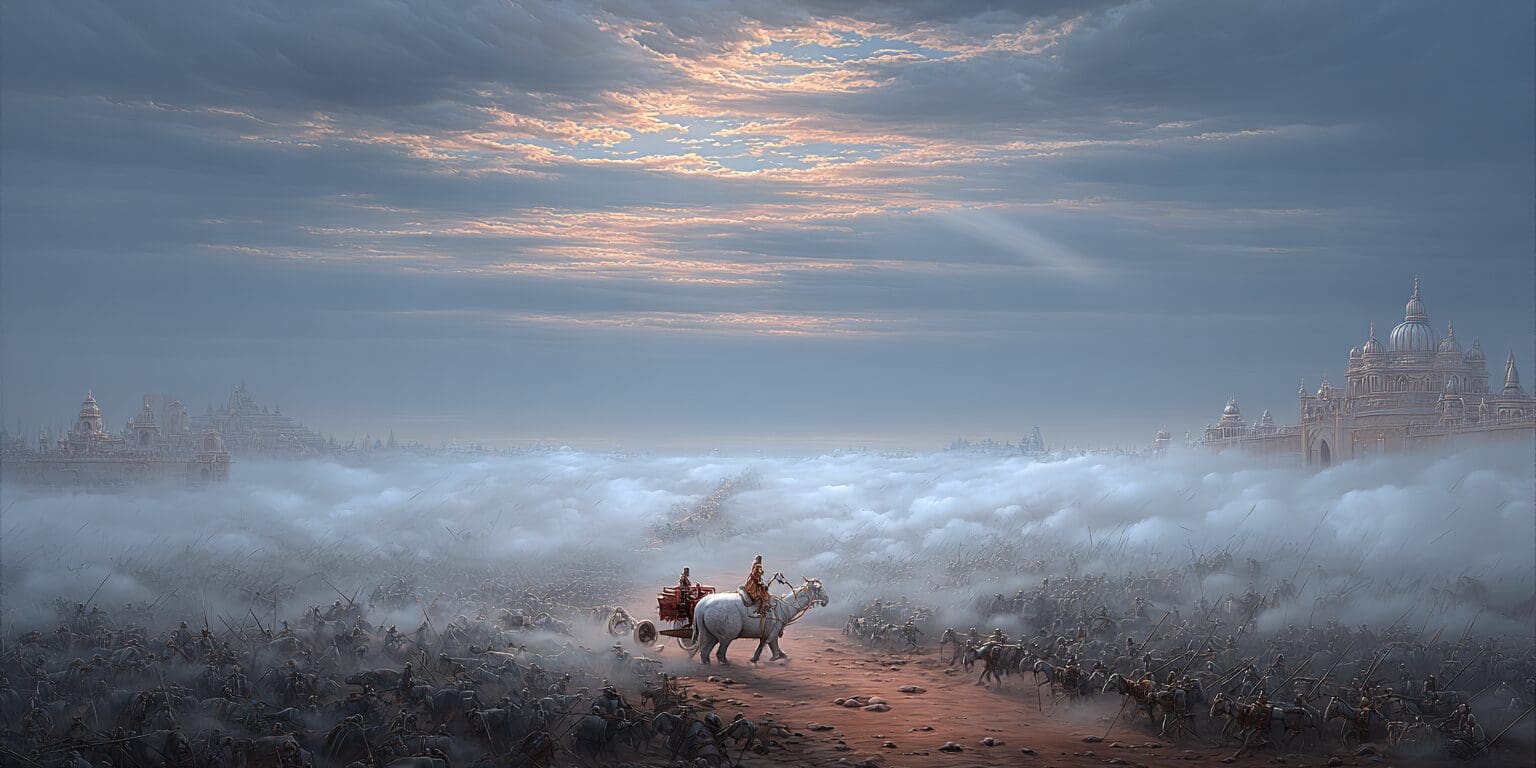
Then, Krishna and Arjuna, seated in a magnificent chariot drawn by white horses, blew their divine conches.
White horses. A magnificent chariot. Two figures — one divine, one human — side by side.
This is the image the Gita has been building toward. Everything before it — Dhritarashtra’s blindness, Duryodhana’s calculation, the naming of warriors, the sound of drums — has been establishing the outer field. Now we arrive at the inner one. The chariot is not only a vehicle. In the Kaṭha Upaniṣad, the body itself is a chariot, the intellect the charioteer, the self the passenger. The Gita is already thinking in multiple registers at once.
Arjuna Asks to See
At 1.21, we hear Arjuna speak for the first time:
“Please take my chariot to the middle of both armies, so that I may look at the warriors arrayed for battle, whom I must fight in this great combat. I desire to see those who have come here to fight on the side of evil.”
This is important. Arjuna asks to look. He is not naive — he knows what is on the field. He has named the conflict himself. He uses the word evil. He is, at this moment, a warrior in full possession of his role and his purpose.
Krishna moves the chariot to the center at 1.24. At 1.25, he says simply: behold these Kurus gathered here.
And at 1.26, Sanjaya tells us what Arjuna sees:
Arjuna could see stationed in both armies — his fathers, grandfathers, teachers, maternal uncles, brothers, cousins, sons, nephews, grand-nephews, friends, fathers-in-law, and well-wishers.
Read that list slowly. This is not an abstraction. Every relationship that has structured Arjuna’s entire life is arrayed on this field, on one side or the other, waiting for him to act.
The Stirring of Compassion
At 1.27, something happens that the Gita names precisely:
Arjuna was overwhelmed with compassion — kṛpayā — and with deep sorrow.
Kṛpayā. Compassion. Not fear. Not cowardice. Not weakness. The Sanskrit word the text uses at this pivotal moment — the word that names what Arjuna feels when he sees clearly what this battle will cost — is the word for compassion.
This is the hidden hinge of the entire Gita, and we lose it almost immediately in the rush to get to Krishna’s teaching.
It is worth pausing on the translation. Kṛpayā is sometimes rendered as pity — and while pity is not wrong exactly, it flattens the word considerably. Pity maintains a distance between the one who feels and the one who suffers. It looks down. The Charter for Compassion defines compassion as “a warm-hearted concern for the suffering of others, with the sincere wish to alleviate it.” That is closer to what is happening in Arjuna at 1.27. He is not pitying his kinsmen from a remove. He is undone by what he sees. The suffering ahead is not abstract to him — it is his teachers, his grandfathers, his friends. His concern is warm, immediate, and accompanied by a genuine wish that things could be otherwise.
That is kṛpayā. And it is the ground from which the Gita’s deepest teaching grows.
It helps to understand something of the Gita’s wider purpose — a subject I’ll explore more fully in another essay, but worth touching here to give kṛpayā its full context. Religious historian Karen Armstrong has written about the threads the Gita was weaving together for people living in India at this time: the urgent need for release from the endless cycle of karma and rebirth; the longing for the Divine not as an abstract principle but as a personal liberator; and something newer and more politically demanding — a concern that extended beyond one’s own in-group. This last thread was not incidental. The Gita was in part addressing princes who governed empires — men whose decisions affected not just their kin but entire populations. The text was helping build a social contract, asking its audience to expand the circle of moral concern.
Compassion is “a warm-hearted concern for the suffering of others, with the sincere wish to alleviate it.”
Charter for Compassion
Kṛpayā — Arjuna’s compassion at 1.27 — is where that expansion begins. He does not grieve only for his side. He sees both armies. He sees the suffering ahead for everyone on that field. His heart breaks open not tribally but universally.
This is not weakness. In the context of what the Gita is trying to do — philosophically, ethically, civilizationally — it is the most important moment in Chapter One. The crack in Arjuna’s warrior identity is precisely the opening through which a wider teaching can enter.
The Argument Arjuna Makes
At 1.28, he speaks:
“Seeing my own kinsmen arrayed for battle here and intent on killing each other, my limbs are giving way and my mouth is drying up.”
From 1.29 through 1.35, he elaborates: “I do not foresee how any good can come from killing my own kinsmen in this battle.” He is not refusing to fight because he is afraid. He is refusing because he can see the consequences — the suffering, the grief, the destruction of families, the unraveling of the social fabric. He is making a philosophical and ethical argument. He is asking, with genuine urgency: what kind of victory is this?
At 1.40 through 1.46, he goes further — describing how this action risks adharma on a cosmic scale. The destruction of family lineages. The collapse of ancestral duties. The unraveling of the world.
This is not a man having a random panic attack. This is a man in a genuine crisis of conscience — caught between two forms of dharma that cannot both be honored. His kula dharma — his duty to family, to kinship, to the web of relationship — is in direct conflict with his kṣatriya dharma — his duty as a warrior, to fight what is adharmic, to protect the order of the world.
He cannot do both. And he knows it.
The Bow Is Put Down
At 1.47, Sanjaya closes the chapter:
“Speaking thus, Arjuna cast aside his bow and arrows, and sank into the seat of his chariot, his mind in distress and overwhelmed with grief.”
At 2.1, Sanjaya completes the vignette: Arjuna’s eyes are filled with tears.
This is viṣāda — often translated as despondency or grief, sometimes as anguish. Chapter One is formally titled Arjuna Viṣāda Yoga — the yoga of Arjuna’s grief. That it is called a yoga at all is significant. Even this collapse — especially this collapse — is part of the path.
Krishna’s Response — And Its Difficulty
And then Krishna speaks.
What he says at 2.2 and 2.3 is worth sitting with carefully, without rushing past it:
“My dear Arjuna, how has this delusion overcome you in this hour of peril? It is not befitting an honorable person. It leads not to the higher abodes, but to disgrace. Do not yield to this unmanliness. Give up such petty weakness of heart and arise, O vanquisher of enemies.”
Unmanliness. Disgrace. Petty weakness.
I want to be honest with you: this is a difficult passage. And I do not think the difficulty should be explained away.
Krishna is speaking to Arjuna in the language of kshatriya culture — the language of honor, of martial identity, of what it means to be a man of Arjuna’s caste and training. One reading is that he is meeting Arjuna exactly where he is, using the vocabulary most likely to reach him in this moment, before pivoting to a far deeper teaching. That is plausible. It is arguably what happens.
But the words are still there. Unmanliness. And the compassion — kṛpayā — that the text named so carefully at 1.27 has disappeared from Krishna’s framing entirely. What Arjuna felt when he saw the suffering ahead of him is now being called delusion. Weakness. Disgrace.
The Gita contains this tension. I do not think we serve the text — or ourselves — by resolving it too quickly. Reading the Gita honestly means reading it with both hands: the profound philosophical teaching it is building toward, and the cultural context it could not entirely transcend.
Arjuna pushes back at 2.4: “How can I shoot arrows at those deserving of my respect?” And at 2.7 he says plainly: “I am confused about my duty.”
At 2.9, Sanjaya tells us Arjuna puts down his bow a second time and refuses to fight.
And then, at 2.11, Krishna begins to teach in earnest.
Why Compassion Matters
Here is what I keep returning to: the Gita’s great philosophical teaching about the ātman — the eternal self, the witness beyond body and mind — arrives not in spite of Arjuna’s compassion but because of it. It is the opening that kṛpayā creates. His heart breaks open on that field. He sees suffering clearly and cannot unfeel it. And that crack — that inability to simply do the warrior thing and fight — is what makes him available to teaching he would never have needed otherwise.
Krishna will go on to offer one of the most luminous accounts of the self, of action, of liberation, of devotion in all of human literature. But it is Arjuna’s compassion that calls it forth.
For women reading the Gita — women who are so often the ones who see the suffering, who feel the cost of conflict in their bodies before anyone has named it, who ask what kind of victory is this when everyone else is still counting strategy — Chapter One is not the preamble. It is the beginning of the teaching.
Arjuna’s viṣāda is not a problem to be solved. It is the door.
The Women’s Gita Circle reads the Bhagavad Gita slowly, carefully, and honestly — in Sanskrit and in English, with full awareness of what the text has been used to argue and deep faith in what it actually contains. We meet biweekly on Zoom, and the circle is free while the community is growing. If this essay opened something in you, the circle is where we continue.
If you are new to the Gita and would like a more structured entry point before joining the circle, I recommend my workshop, The Gita’s Garden: A Beginner’s Way Into the Bhagavad Gita — a gentle, unhurried introduction to one of the world’s great philosophical texts, designed for women who are curious but don’t know where to begin. Details here.
You might also enjoy Your Dharma Flower — a short, Gita-inspired quiz that helps you understand how you naturally meet challenge, responsibility, and change on your path.
It’s a simple way to begin bringing these teachings into your own life.
Take the Dharma Flower quiz here.
The side door is always open.
A Note on Translation
The renderings in this essay are my own working summaries, informed by the translations of Eknath Easwaran and Paramahansa Yogananda, as well as ongoing translation work developed in collaboration with Nischala Joy Devi. They are offered as interpretive guides rather than literal translations.


