


What the Bhagavad Gita’s Most Famous Verse Really Teaches About Karma, Action, and Inaction
Meeting on Zoom is nothing like sitting in the shaded forests of the Upanishads. And yet – something essential can still happen there.
In our first gathering of the Women’s Gita Circle, I watched it happen in real time: a space opened up, unhurried and honest, where women who have both lived life and studied the Gita could speak plainly about what its teachings actually ask of us. This has been a long dream of mine – not a study group in the passive sense, but a genuine philosophical conversation among practitioners who are willing to sit with hard questions. What we found, even through a screen, was exactly that.
We began with verse 2.47 – one of the Gita’s most quoted and most misunderstood verses:
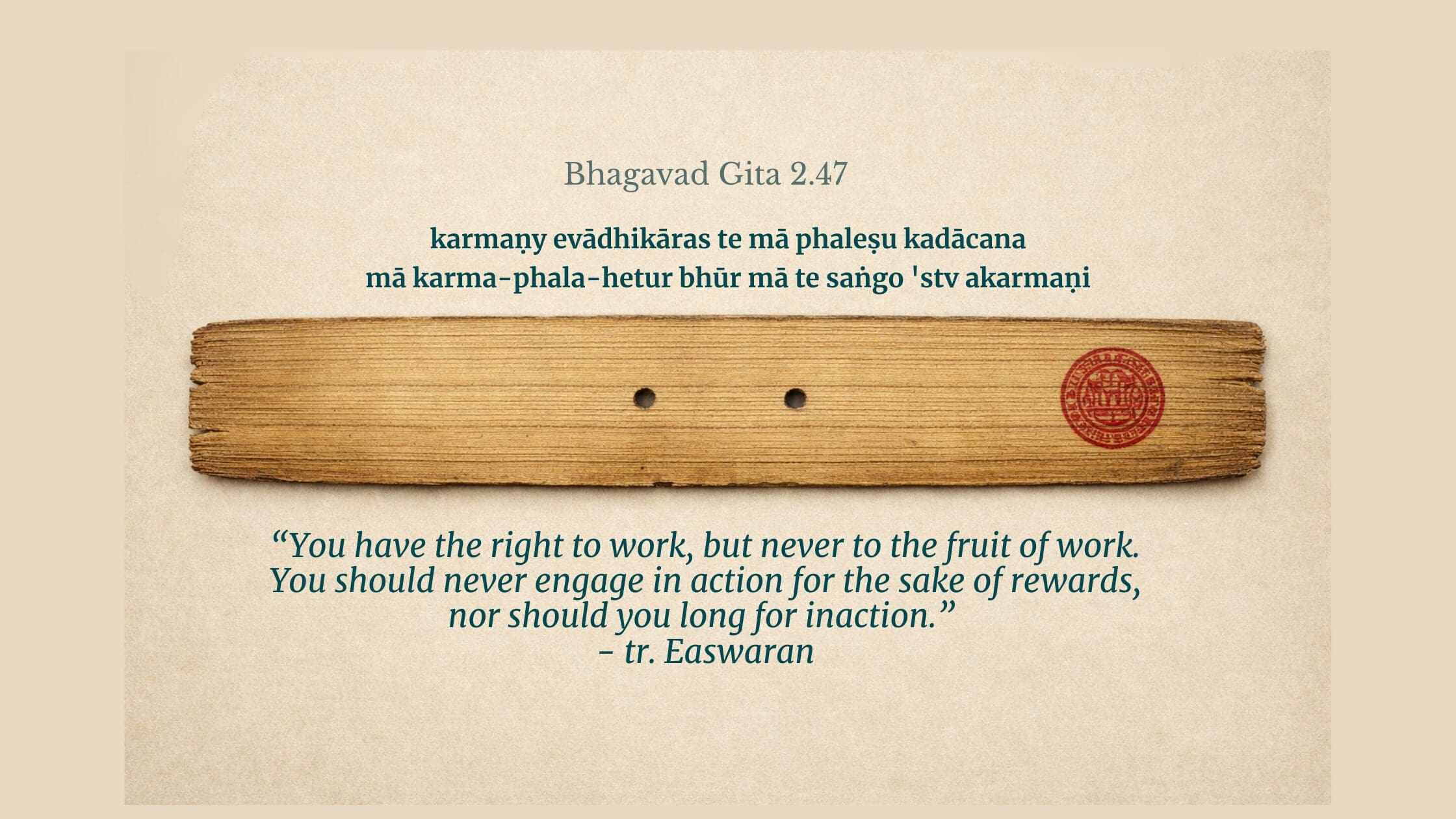
“You have the right to work, but never to the fruit of work. You should never engage in action for the sake of reward, nor should you long for inaction.” — tr. Eknath Easwaran
In the West, we tend to hear this as something like a productivity ethic: do the work, don’t obsess over outcomes. Admirable advice. But read the Sanskrit, and something older and stranger comes into focus:
karmaṇy evādhikāras te mā phaleṣu kadācana mā karma-phala-hetur bhūr mā te saṅgo ‘stv akarmaṇi
The subject here is not your career. It is karma in its classical sense – continuous action, the force that binds living beings to samsara, the very thing that yoga exists to address. Not postures. Liberation from suffering. The Gita is not a self-help text that arrived early. It is a philosophical intervention into the deepest mechanisms of human bondage.
I want more women reading it this way. Not because Sanskrit fluency is a prerequisite for meaning – it isn’t – but because the moment you encounter the original language, even haltingly, something shifts. The text stops being a translation of someone else’s understanding and begins to speak directly. Editions like Feuerstein or Sargeant reward this kind of encounter. I know not every practitioner will want to go there – but some do, and feel stopped before they start. That is a threshold worth crossing together.

Our contemplative question for this first circle was simply: Where in your life right now is inaction the easier choice and what might be asking you to act anyway?
What I can tell you is that the Gita has a particular quality when it meets a real question from a real life. It cuts through personal narrative with what I can only call a velvet blade – precise, and somehow not unkind. Krishna frames everything as a riddle you cannot quite solve, which means the verses become long-term contemplative meditations rather than answers. You carry them. They work on you.
What was said in the circle stays in the circle. But I will say this: writing publicly, teaching openly, and bringing this circle into existence was, for me, the easier thing not to do – for a long time. Verse 2.47 asked me to act anyway.
I believe in the Gita’s capacity to gather people around essential questions – about action, about suffering, about what it means to live with integrity inside an ordinary life. That belief is what this circle is built on.
If you’ve been sitting at the edge of something like this, wondering whether it’s for you – consider this an invitation.
The Women’s Gita Circle meets biweekly. Learn more at kamalaroseyoga.org.


