


Women’s Dharma, the Ethic of Care, and the Bhagavad Gita’s Battlefield
The personal is political. — Yoko OnoThe Bhagavad Gita opens with a shocking image.
For a spiritual text — one that will go on to offer some of the most luminous philosophical teachings in human literature — it begins in a difficult place. An army assembled. Two sides facing each other across a dusty plain. The blind king Dhritarashtra, seated at a distance, asking his aide to tell him what is happening.
On its surface, it is a scene of war. And for many women encountering this image, it does not immediately feel like an invitation.
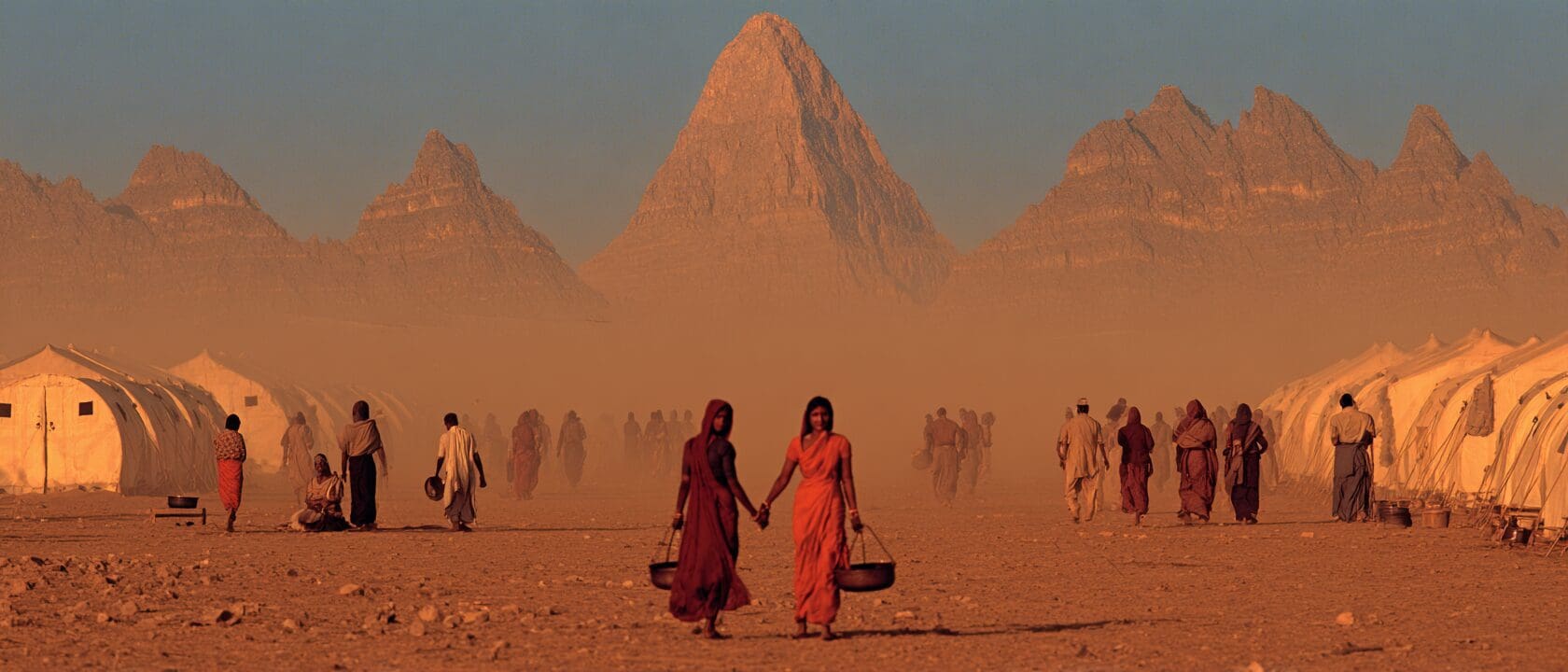
We know what is asked of us on battlefields. We feed the soldiers before they go. We tend them when they come back broken. We prepare the bodies of the ones who don’t return. We hold the children. We hold the grief. We hold the whole structure of life together in the background of a story that will not remember us by name.
The Personal Is Political
A few years ago I stood inside Yoko Ono’s retrospective at the Tate in London, and encountered a piece that has not left me.
She called it The Personal Is Political.
On the ceiling: an image of a naked breast, with text inviting the viewer to think of their own mother. On the walls: thousands of written fragments — memories, apologies, odes, manifestos — from people around the world, circling the same recognition: that we were all once held. That someone chose to care for us. That this fact precedes every system of power, every political philosophy, every battlefield named in any sacred text.
Visitors were invited to add their own.
Layer upon layer, the walls filled with testimony. People remembering the most basic thing.
The personal is political. The one who fed you was doing dharmic work. The one who nursed the wounded was on the field. The care network is not the margin of the story. It is the ground the story grows in.
The Field — Inner and Outer
The Gita’s first four words carry everything:
Dharma-kṣetre kuru-kṣetre.
Kṣetra means field. Not battlefield alone — but field in the oldest sense. Tilled ground. Cultivated earth. The place where care shows and neglect shows, where what you bring determines what grows.
The Gita names two fields at once. Dharma-kṣetra — the field of right action. Kuru-kṣetra — the field of lineage, belonging, identity. Both names. Same ground.
This is the first teaching of the Gita: the sacred and the contested are not separate fields.
The battlefield is also your body. The soil you tend is also your interior life.
So the question is already present, before it is ever asked directly:
How are you tending your field?
A field is not passive. It requires attention, labor, and the willingness to act without certainty of outcome. The warrior and the farmer share this relationship to the earth.
This is karma yoga — not as productivity philosophy, but as the oldest human relationship to the ground beneath your feet.
The Gita’s first four words carry everything:
Dharma-kṣetre kuru-kṣetre.
Kṣetra means field. Not battlefield alone — but field in the oldest sense. Tilled ground. Cultivated earth. The place where care shows and neglect shows, where what you bring determines what grows.
The Gita names two fields at once. Dharma-kṣetra — the field of right action. Kuru-kṣetra — the field of lineage, belonging, identity. Both names. Same ground.
This is the first teaching of the Gita: the sacred and the contested are not separate fields.
The battlefield is also your body. The soil you tend is also your interior life.
So the question is already present, before it is ever asked directly:
How are you tending your field?
A field is not passive. It requires attention, labor, and the willingness to act without certainty of outcome. The warrior and the farmer share this relationship to the earth.
This is karma yoga — not as productivity philosophy, but as the oldest human relationship to the ground beneath your feet.
Zooming Out: Who Is on This Field?
Chapter 1 of the Gita reads like an inventory. Warriors named. Lineages listed. Conches blown. The dharma of the kshatriya — the warrior class — established and celebrated.
A roll call of power.
I cannot read it now without hearing something beneath it.
The listing of names — the administrators, the collaborators, the architects of systems that shape ordinary life — the networks of power whose names we now recognize as patriarchy — I hear them in Chapter 1. The men who run the visible stage of conflict, whose decisions define the conditions the rest of us live inside.
This is not a distortion of the text. It is the text doing what it has always done: meeting us in our actual moment and asking what we will do.
But the chapter makes something else clear:
we are not in that list.
To find women in this scene, we have to widen the frame.
There we find everyone else. The ones cooking, tending, nursing, grieving, rebuilding. The ones who hold what war breaks.
These are not minor characters. They are the majority of the world.
So the question becomes:
What is the dharma of those never given a place on the field?
The Second Sex and the Ethic of Care
Carol Gilligan named what she called an ethic of care — a moral framework rooted in relationship, responsibility, and the maintenance of connection.
Women have practiced this for millennia without it being named as philosophy.
The Gita’s battlefield operates through a different ethic — duty, honor, righteous action. Do your duty. Fight the good fight. Release the outcome.
This is not wrong. But it is incomplete.
Simone de Beauvoir named women “the second sex” — not second in value, but second in the story’s grammar.
What the Gita offers, I think, is not the warrior’s dharma but something more radical:
The recognition that the ātman — the witnessing self — is the same in every body.
Not male. Not kshatriya. Not defined by role.
And from this recognition, we can say clearly what the text itself leaves implicit:
The ethic of care is dharma.
To regulate a nervous system in a collapsing world.
To tend to relationship.
To hold continuity where systems fail.
This is not peripheral work.
This is the field.
The Battlefield Women Actually Live In
For most women, the battlefield appears not in combat but in relationship.
In care networks — the intricate, often invisible webs of responsibility that structure daily life.
These are our kṣetra. Our fields of belonging.
And over time, they can become strained. Imbalanced. Exhausted.
We find ourselves where Arjuna found himself — uncertain, overwhelmed, unable to locate our center.
In the second half of life especially, the field shifts.
Bodies change. Identities dissolve. Roles fall away.
Sometimes the body itself becomes the most contested territory.
And here the Gita speaks directly:
Your body is a kṣetra.
It is ground that requires tending.
It is not an obstacle. It is the field.
What Krishna Says First
When Krishna speaks, he does not offer comfort. He offers clarity.
Aśocyān anvaśocas tvaṃ prajñā-vādāṃś ca bhāṣase.
You are grieving for those who should not be grieved for.
This is not a dismissal of grief. It is an invitation to look more carefully.
What, beneath what has changed, remains?
The ātman is not above the field. It is the capacity to remain present within it.
To act from clarity rather than confusion.
So the question becomes:
Where, in the middle of everything that is changing, can you locate that in yourself?
This Is Your Field
Dharma prevails in the Mahabharata.
And the women who tended the wounded, buried the dead, and held the world together through and after the war — they are part of that victory.
The triumph of dharma does not belong only to the warrior.
It belongs to everyone who showed up on the field.
We are not on the margins of this story.
We are the ground it grows in.
The ethic of care is not a consolation for those who were not given the hero’s role.
It is a necessary dharma — one the Gita’s philosophy fully supports, even when its cultural frame did not.
We read it with both hands: the tradition as it was given, and the truth it contains that exceeds it.
Dharma-kṣetre kuru-kṣetre.
The sacred field and the contested one are the same ground.
Tend it carefully.
You are both the farmer and the field.
Invitation
If this opened something in you — a question, a recognition, a place where the Gita meets your life — the Women’s Gita Circle is where we continue.
We gather biweekly on Zoom. Women reading the Gita together, in Sanskrit and in English, with full awareness of its history and deep trust in what it offers.
This is a philosophical conversation, not a lecture.
Come as you are. Bring what is real.
And catch my dialogue with Nischala Joy Devi on A Woman’s Gita podcast.


