What the Bhagavad Gita actually says about how dharma survives
Nischaladevi and I have just begun Chapter Four of the Gita on the podcast — the chapter where Krishna speaks of the Avatāra. This essay grows from that conversation.
“A huge amount of the important work is done by nice ladies. And I think a lot of people … want social change to look like the French Revolution or Che Guevara or something like that. And so the fact that nice ladies actually change the world, maybe it’s about the fact that changing the world is more like caregiving than it is like war.”
Rebecca Solnit said this in a recent New York Times interview. Liz Bucar, writing about it, named what Solnit was doing as theology — reaching, without translation, without apology, for the oldest frameworks we have for understanding how the world actually gets better.
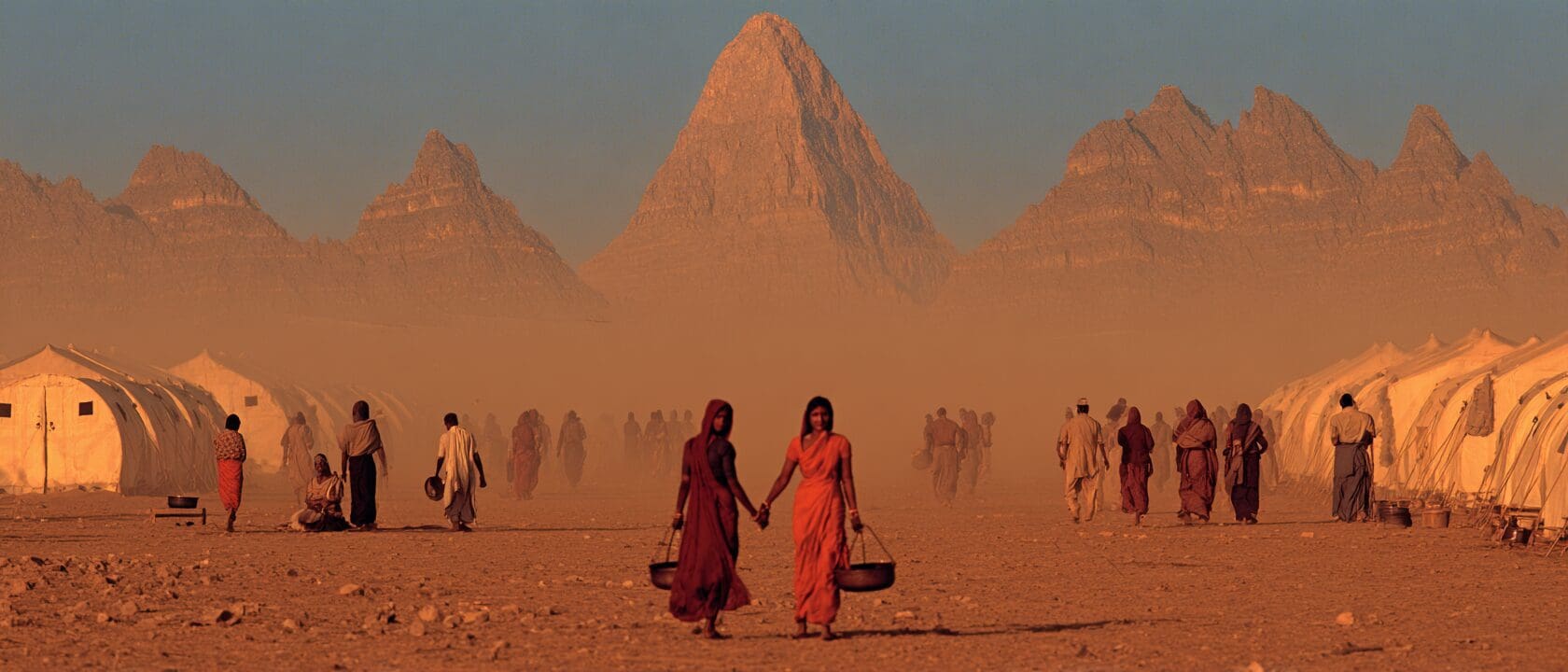
I thought immediately of the yoga community. Of the women who have been carrying this tradition for decades — in strip-mall studios, in community centers, in living rooms on Zoom — holding the rooms, tending the practice, transmitting something they could feel was profound without always having the philosophical language to say precisely what. Without recognition. Without Sanskrit. Doing the work the Gitā describes as central, while the hero myth looked elsewhere.
The Bhagavad Gitā has been carried, largely, by nice ladies. Yoga teachers in studios. Women who learned the poses and the breath and some of the philosophy, who held the rooms and tracked the energy and made the spaces safe – often without being given the intellectual tools of the tradition they were transmitting. Without recognition. Without Sanskrit. On the margins of the battlefield, as I wrote in a previous essay, doing the work the text itself describes as central, while the hero myth looked elsewhere for its avatars.
I’ve been teaching this text for decades. I’ve been saying some version of what Solnit said for most of that time. What I want to do here is show you where the Gitā says it first – in a single verb most translations pass over quickly.
The verb the hero myth hides
Here is Chapter 4, verse 8:
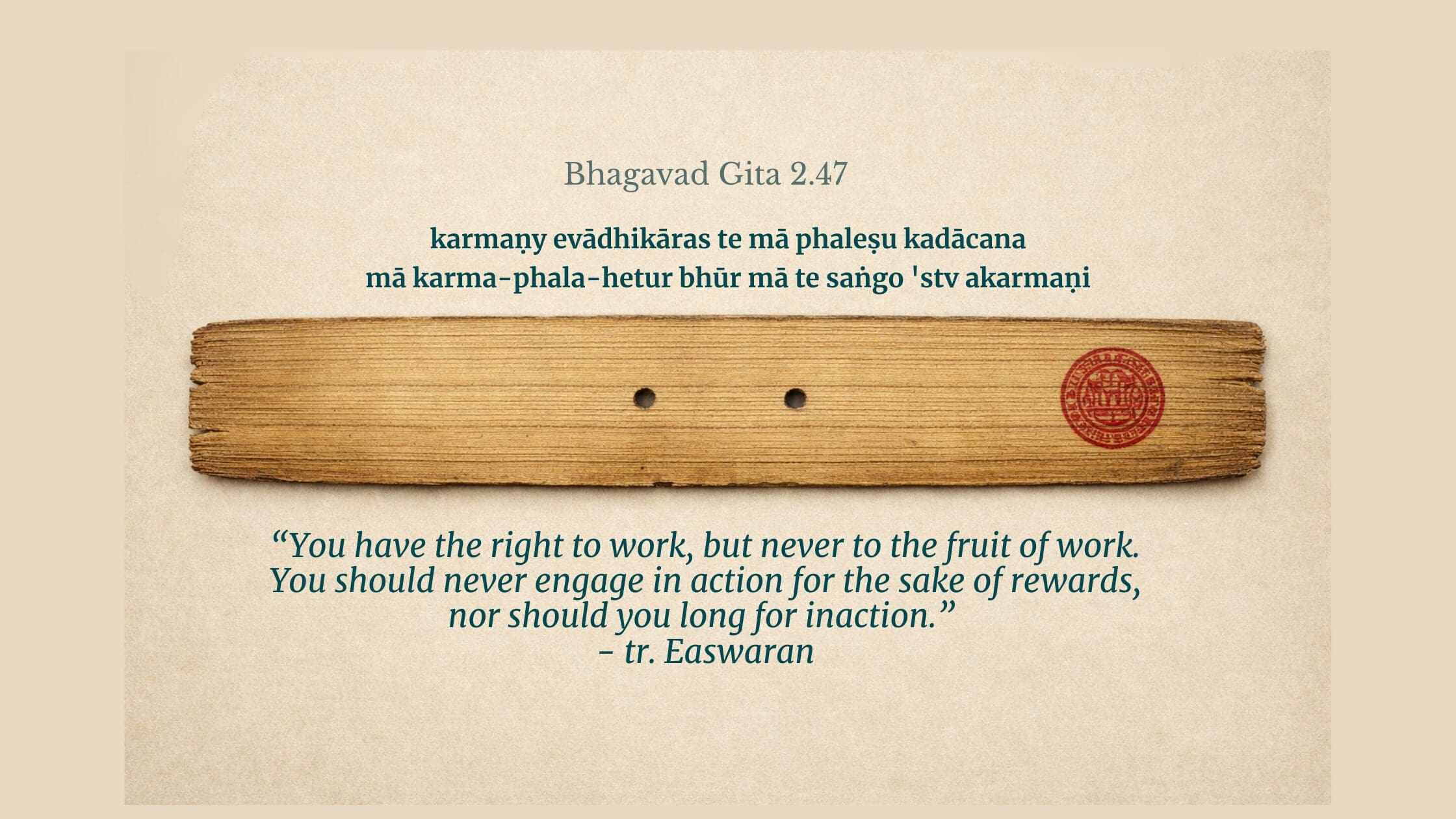
paritrāṇāya sādhūnāṃ vināśāya ca duṣkṛtām dharma-saṃsthāpanārthāya sambhavāmi yugé yugé
“Whenever there is decay of righteousness, O Bhārata, and there is exaltation of unrighteousness, then I Myself come forth.” – tr. Annie Besant
We are in the Kaliyuga. The one-legged age. The tradition imagines dharma as a table standing on four legs – truth, compassion, austerity, generosity. In the first age, all four legs hold. As the cycle turns, one leg at a time gives way. Here, in the age we inhabit, dharma stands on one. Anyone paying attention knows what that feels like right now.
And into this age, the text says: I arise.
The question is how. And the answer is in a verb most translations pass over quickly.
Sambhavāmi.
I come into being. I arise. I manifest. The word is sam — together, completely — combined with bhū: to become, to be born, to take form from within conditions. This is not “I descend from above.” This is not the superhero arriving from outside the story. Sambhavāmi is the divine emerging within history — taking form through the age, through its people, through the communities that make themselves available to it.
One way to think about this: sambhavāmi is the divine as the conscience of humanity. Not separate from history, surveying it from a distance. Present within it, arising through the ones who refuse to look away.
This is what Annie Besant understood when she read the Gita as the story of the Logos — not a personal God who periodically visits creation, but the animating principle by which the world continuously comes into being. She wrote that the Avatāra “descends” — but descends is the language we use when we think of the Supreme as far-off, when truly it is the all-pervasive Life in which we live. To the outer eye it looks like a coming down. But the Avatāra is also the Īśhvara of the human Spirit, the Supreme Self of whom the individual spirit is a portion, an aṃśa. The divine presence on Kurukṣetra, she argued, operated through a farsighted, unswerving will – guided by a vision of history that divine eyes held past and future as one eternal present.
Sambhavāmi, then, is not the arrival of a savior.
It is a description of how dharma has always survived.
The avatar the hero myth misses
Because the hero archetype lives not just in culture but in our own minds, we tend to picture Krishna’s avatāra as singular. One divine figure, one body, one battlefield. But Krishna in the Gita is never alone.
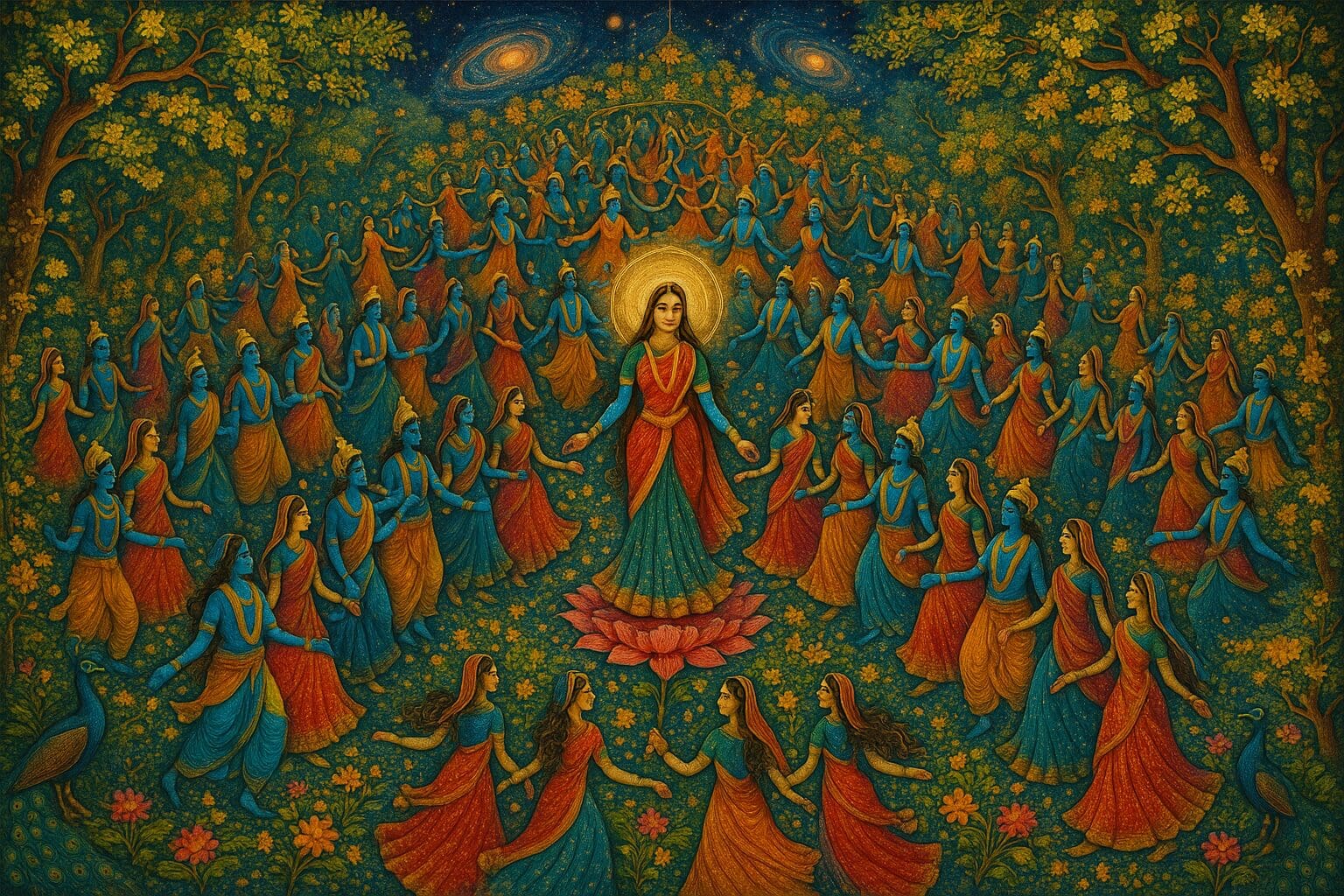
He arrives with Arjuna. He is embedded in the Yādavas — the community of his birth, his people, his belonging. He is the Krishna of the Gopīs and Gopālas, the cowherd community of Vṛndāvan who knew him before the philosophy, before the battlefield, in the dailiness of tending and devotion. He is inseparable from Balarāma, his brother, the other face of the same force.
The avatāra, read carefully, is always relational. Always communal. The divine arises into relationship, not above it.
Thich Nhat Hanh said it in our own century: the next Buddha will be the sangha. The community of practitioners. Not the teacher at the front of the room. The room itself.
The Gitā said it first, in the verb sambhavāmi. Coming into being – through the ones who showed up. Through the nice ladies. Through the people on the margins of the battlefield who were never listed in the roll call of warriors but without whom the tradition would not have survived the night.
Age after age.
When the hero drops his bow
There is a moment in this text that the hero myth almost always misses – and it may be the Gitā’s most important turn.
Arjuna, the hero, the archer, the one the whole tradition has been building toward, steps out of his role entirely. He surveys the battlefield. He sees his teachers, his grandfathers, his friends arrayed on both sides. And he is overwhelmed by kṛpayā.
Compassion.
Not fear. Not weakness. Not – despite what Krishna’s first sharp words will call it – unmanliness. The Sanskrit names it precisely: a warm-hearted, immediate, embodied concern for the suffering ahead. He sees it clearly before anyone else names it. He cannot pretend otherwise. The hero drops his bow.
And in that collapse, the Gita’s real teaching becomes possible.
Kṛpayā is not a detour from the argument. It is the argument’s beginning – the crack through which eighteen chapters of philosophy enter. What follows is addressed not to the warrior standing tall, but to the one who faltered. Who felt what was at stake. Who could not look away.
Kṛpayā is the turn toward compassion – the moment of being moved. What the broader yoga tradition gives us, in the practice of karuṇā, is the discipline that follows: one of the four brahma-vihāras, the “divine abodes” shared between yoga and Buddhist mind-training. Karuṇā is not a feeling you hope to have on good days. It is something you cultivate – steadfast relational attentiveness, the capacity to remain present with suffering without being consumed by it, and to act from that presence. You train it the way you train concentration in meditation. Slowly. Repeatedly. Over a lifetime.
The Gitā opens with the moment the hero is broken open by kṛpayā. The tradition asks us to make that opening into a practice.
This is not the soft margin of yoga. It is its spine. And it is, as Solnit says, exactly what changing the world actually looks like – less like the French Revolution, more like showing up.
The longer story
Liz Bucar, writing about Solnit’s interview, named what Solnit was doing as theology without knowing it. Solnit, she wrote, has a method for sustaining hope: holding the longer arc of history, reading backlash as evidence of how much ground has actually been won, insisting we are more powerful than we feel. That’s a lot like how religious communities have carried hope across generations of suffering. They hold the longer story when the present moment is too dark to bear.
Annie Besant – nineteenth-century reformer, theologian, suffragist, and one of the first Western women to take the Gita seriously as philosophy – would agree. Reading the battlefield of Kurukṣetra as world history, she argued that the one who understands the Gita this way can stand unshaken amid the crash of breaking worlds — because what looks like catastrophe on one plane is, on another, the preparation for what comes next. To the divine eyes she described as Logos, past and future were not distant. They were one eternal present.
Vandana Shiva – physicist, ecofeminist, and a reader of the Gita who has said that her tradition taught her how to act without being destroyed by the results – put it differently:
“We must continue to create a new world, seed by seed, person by person, community by community, until this planet is embraced in a circle of resurgent love and resurgent life.”
Solnit, Bucar, Besant, Shiva. Four women, across centuries of crisis, arriving at the same place: hold the longer arc. Read the backlash as evidence of ground won. The tradition has survived before – not through institutions, not through heroes, but through the people who kept carrying it.
This is not optimism. Optimism claims to know how it ends. What the Gita holds is something harder and more honest: the refusal to let the Kaliyuga be the only thing that’s real. The knowledge that we have been here before. That dharma has stood on one leg before. That the corrupt have taken control before. And that the tradition survived – not in institutions, not in temples, not through heroes – but through the people who kept carrying it. Who kept arising.
Sambhavāmi.
The women who have been doing this work for decades without recognition have been part of this arising. The ones on the margins of the battlefield, doing the work the text calls central. The ones for whom changing the world has always looked more like caregiving than war.
They have been sambhavāmi – the Logos – all along. That is not peripheral to the tradition. It is how the tradition survives.
How would this change the way we live?
If the avatāra is not a singular hero descending to save us, but the conscience of humanity arising through communities willing to do the work – what does that ask of us?
It asks us to take our practice seriously, not as self-improvement but as preparation. To understand karuṇā not as a feeling but as a discipline. To show up for the sangha not because it is comfortable but because the sangha is, in this reading, where the divine actually lives.
It asks us to read backlash as evidence of ground won rather than ground lost – to hold the longer arc when the present moment is too heavy to bear.
And it asks us to stop waiting for the hero. To recognize that we have been sambhavāmi all along — coming into being, taking form within the conditions of our age, arising through each other.
The Gita was waiting for us to read it this way.
The Women’s Gita Circle meets this month to read Chapter 13 – where Krishna describes himself as the eyes of all beings, the hands of all beings. Not above creation. As creation. It is where the argument this essay has been building finds its fullest expression in the text.
If something here opened a question, the circle is where we follow it. We gather biweekly on Zoom – women reading the Gita together, in Sanskrit and in English, with full awareness of what the text has been used to argue and deep faith in what it actually contains. The conversation is the practice. Register here.
The side door is always open.
A Woman’s Gita is a podcast and ongoing project by Kamala Rose and Nischala Joy Devi – a verse-by-verse reading of the Bhagavad Gita by and for women practitioners. This essay grows from our recent conversation on Chapter 4, verses 8–11. You can listen here.